

UPSC and KAS Mains
Write better essays. Get your marks and feedback from our mentors.
A free practice ladder from 50 words to the full exam essay. Write or upload, get evaluated, then revise and improve.
- Free registration, free evaluation
- Tips and model essays at every level
- Rewrite and resubmit as many times as you like
The training ladder
Six steps. Start where you are comfortable and move up when you are ready. Swipe to see all steps.
Know the paper
Inside the UPSC essay paper
Two essays in three hours. The paper is divided into Section A and Section B, and you write one essay from each, choosing from four topics in each section.
Section A
Tends to carry abstract and philosophical ideas, often a single line of thought to unpack.
Section B
Tends to lean towards society, economy and policy, where examples and balance matter.
The line between the two is not rigid, and the mix changes from year to year, so prepare for both.
What the score bands look like
Seldom seen. A thoughtful core idea backed by evidence from several fields.
A sharp central argument, a tidy flow and a few well-chosen literary touches.
The range in which most selected candidates score.
Solid points, but a loose structure or examples that feel dated.
Reads like a description, sounds borrowed, or wanders away from the topic.
Indicative only, drawn from how toppers' scripts have been studied. UPSC does not publish an official scale.
Themes that return again and again
The essay paper has no notified syllabus. These eight areas keep appearing across past papers.
Topics from recent years
- 2024“Forests precede civilizations and deserts follow them.”
- 2023“Thinking is like a game, it does not begin unless there is an opposite team.”
- 2022“Forests are the best case studies for economic excellence.”
- 2021“The process of self-discovery has now been technologically outsourced.”
- 2020“Life is a long journey between being human and being humane.”
One topic per year, for practice. Please see the official UPSC papers for every topic and the exact wording.
Spend your 90 minutes like this
A plan for each essay, so that both fit comfortably in the three hours.
- 10 minChoose and brainstormScan the topics, pick the one you can say most about, and jot down every idea.
- 10 minOutlinePlan at least six dimensions and two strong examples to anchor the essay.
- 65 minWriteKeep to your outline and make each paragraph do one job.
- 5 minReviewCheck grammar, sharpen the title and tighten the closing lines.
Know your question types
Kinds of essay topics
Directive words in GS Mains questions
The first word of a question tells you how to write the answer. Learn what each one asks for.
- Define
- State the exact meaning of a term or concept, briefly and precisely.
- Describe
- Give a clear account of what something is or how it works, in detail.
- Explain
- Give reasons and show how or why something happens.
- Elaborate
- Expand a point in more depth with details, reasons and examples.
- Elucidate
- Make a point clear by explaining it fully, often with examples or illustrations.
- Illustrate
- Make the answer clear with examples, cases or data.
- Discuss
- Examine a topic from several angles, giving arguments for and against.
- Analyse
- Break the topic into parts and examine each, showing how the parts relate.
- Examine
- Look closely at a topic, test it against facts and arguments, and reach a view.
- Comment
- Give your reasoned opinion, supported by facts.
- Evaluate or Assess
- Judge the worth, success or impact of something, weighing strengths against weaknesses.
- Critically examine or Critically analyse
- Look at both merits and demerits, question the assumptions, and give a balanced judgement.
- Critically review
- Weigh the strengths and weaknesses of a policy, work or argument and arrive at a verdict.
- Compare
- Show similarities and differences between two or more things.
- Differentiate or Distinguish
- Bring out the differences between two things clearly.
- Justify
- Give reasons and evidence to support a statement or decision.
- Substantiate
- Back a claim with facts, data or examples.
- Highlight or Bring out
- Draw attention to the most important points.
- Enumerate or List
- Name the points one by one, in a short and clear form.
- Outline
- Give the main features or the general plan, leaving out minor details.
- Trace
- Follow the development of something step by step over time.
- Account for
- Give the reasons why something has happened.
Why practise essays with us
How we mark
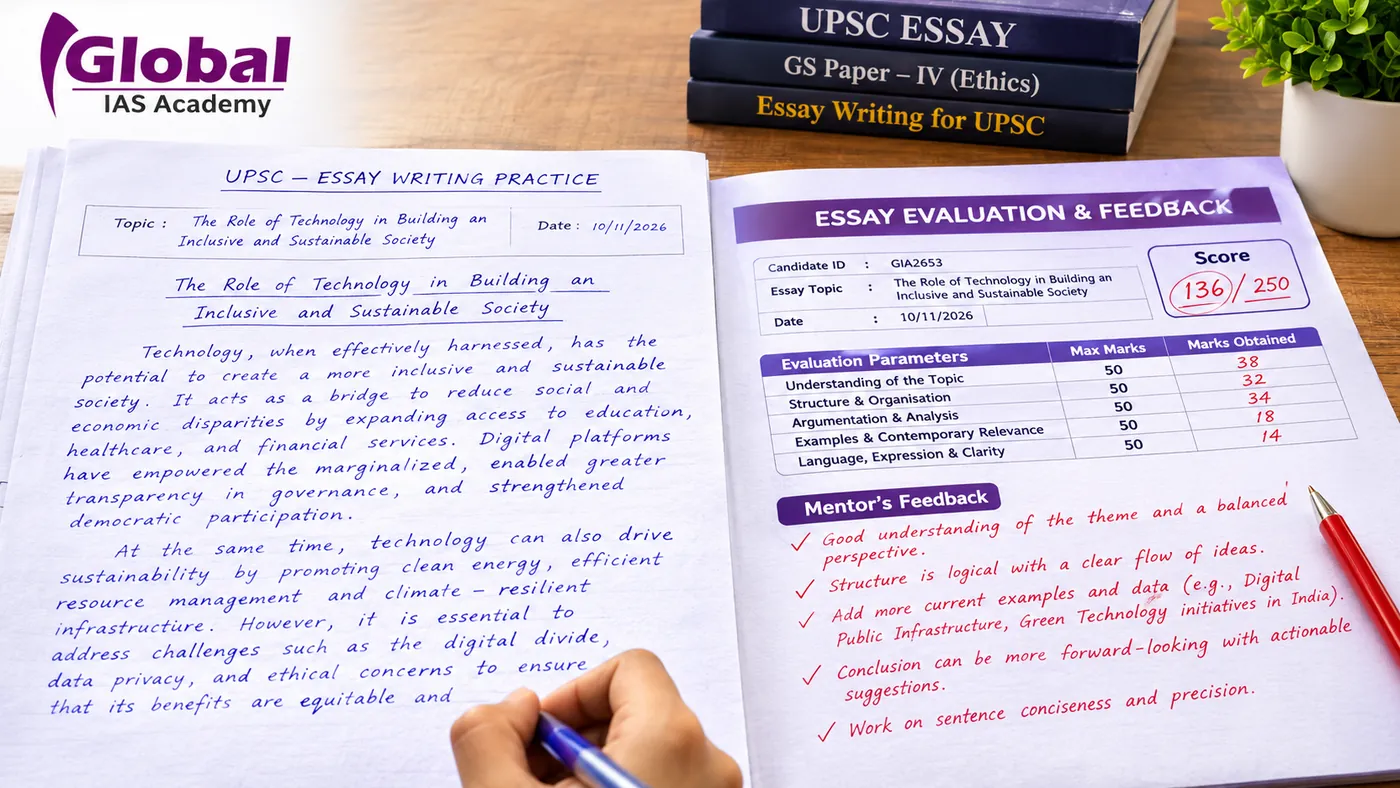
Total: 40 marks. You see every score and the mentor's written feedback.
Questions
Is essay practice free?
Yes. Registration and mentor evaluation of practice essays are free.
How are the essays evaluated?
A mentor reads your essay and gives marks for content, structure, language and depth, with written feedback and next steps.
Can I upload a handwritten essay?
Yes. Type it, or upload a PDF, photo or Word file of up to 8 MB.
Can I rewrite and resubmit?
Yes. Open any evaluated essay and revise it. Each attempt is saved so you can see your progress.
I forgot my password. What do I do?
WhatsApp us on 99640 13666 and we will reset it for you.